EMT Practice Test

1. Question Content...


Question List

Question1: Which of the following statements about functional testing is correct?
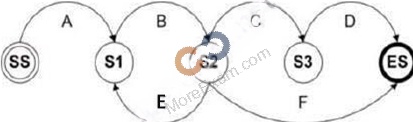
Question2: Given the following state transition diagram:

Which of the test cases below will cover the following series of state transitions?
S1 S2 S1 S2 ES A.
A, B, E, B, F

Question3: Pair the correct test design techniques (i to v) with the category of techniques (x, y and z):
i) Exploratory Testing
ii) Equivalence Partitioning
iii) Decision Testing
iv) Use Case Testing
v) Condition coverage
x) Specification-based
y) Structure-based
z) Experienced-based

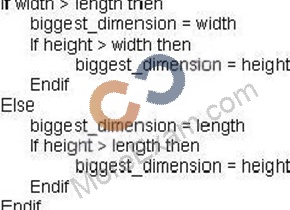
Question4: Given the following fragment of code, how many tests are required for 100% statement coverage?

Question5: Which one of the following provides the BEST description of test design?

Question6: Which of the following is a review process activity?

Question7: Which of the following activities would NORMALLY be undertaken during test planning?
a) Scheduling test analysis and design.
b) Designing Test Conditions.
c) Monitoring test progress.
d) Identifying the objectives of testing.
e) Evaluating test tools.
f) Selecting test metrics for monitoring and control.

Question8: Which one of the following BEST describes the purpose of a priority rating in an incident report?

Question9: Which of the following are the typical defects found by static analysis tools?
a) Variables that are never used.
b) Security vulnerabilities.
c) Poor performance.
d) Unreachable code.
e) Business processes not followed.

Question10: Which of the following are key success factors to the review process?

Question11: Why should expected results be defined before execution?

Question12: Which of the following is a TYPICAL objective of a pilot project for introducing a testing tool into an organization?

Question13: Which ordering of the list below gives increasing levels of test independence?
a) Tests designed by a fellow-member of the design team.
b) Tests designed by a different group within the organization.
c) Tests designed by the code author.
d) Tests designed by different organization.

Question14: Which of the following is a MAJOR activity of test control?

Question15: Given the following sample of pseudo code:
01 Input number of male rabbits
02 Input number of female rabbits
03 If male rabbits > 0 and female rabbits > 0 then
04 Input Do you want to breed (Yes / No)
05 If breed = "No"
06 Print deep male and female rabbits apart!
07 End if
08 End If.
Which of the following test cases will ensure that statement "06" is executed?

Question16: How is the scope of maintenance testing assessed?

Question17: Which of the following matches the activity (i to iv) to its most suitable type of tool (p to s)?
i) Analysis of code structure.
ii)Generation of test cases.
iii)Simulation of the environment in which a component is run.
iv)Analysis of test metrics.
p) Test management.
q) Test design tool.
r) Static analysis tool.
s) Test harness.

Question18: Which of the following are characteristic of test management tools?
a) They support traceability of tests to source documents.
b) They provide an interface to test execution tools.
c) They help to enforce coding standards.
d) They manipulate databases and files to set up test data.

Question19: Which tasks would USUALLY be performed by a test leader and which by the tester?
a) Adapt planning based on test results.
b) Create test specifications.
c) Plan tests.
d) Write or review a test strategy.

Question20: Which of the following is a project risk?

Question21: Which of the following statements is true?

Question22: Which of the following activities would improve how a tool is deployed within an organization?
a) Defining best practice guidelines for users.
b) Roll out the tool across the organization as quickly as possible to all users.
c) Provide technical support to the test team for each type of tool.
d) Introduce a system to monitor tool usage and user feedback.
e) Ensure that the test process is not changed as result of the tool introduction.

Question23: Which of the following is MOST clearly a characteristic of structure based (white-box) techniques?

Question24: Which of the following activities should be performed during the selection and implementation of a testing tool?
a) Determine whether the organization existing test process needs to change.
b) Conduct a proof of concept.
c) Implement the selected tool on a project behind schedule to save time.
d) Identify coaching and mentoring requirements for the use of the selected tool

Question25: An automated air-conditioner is programmed to turn its heating unit on when the temperature falls below
17 and to turn its refrigeration unit on when the temperature exceeds 26. The air-conditioner is designed to operate at temperatures between -10 and +40. Given the above specification, the temperature exceeds 26.
The air-conditioner is designed to operate at temperatures between -10 and +40?
Given the above specification, which of the following sets of values shows that the equivalence partition test design technique has been used correctly?

Question26: Which of the following statements correctly describes the benefit of fault attacks?
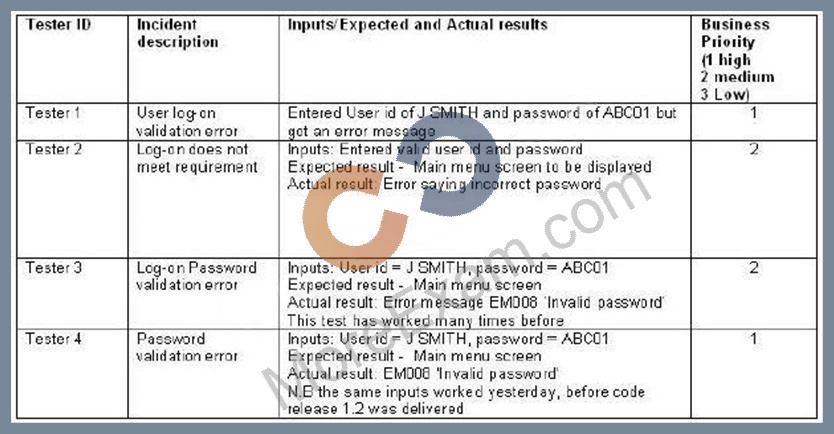
Question27: Four testers have each submitted an incident report in which each reported a problem with the User log-on process. User log-on is a critical component of the system. The table below describes the four defect reports submitted.

Which Tester has reported the incident MOST effectively, considering the information and priority they have supplied?

Question28: Which of the following is a purpose of the review kick off activity?

Question29: Which of the following is an example of a product risk?
Question30: Which of the following activities should be considered before purchasing a tool for an organization?
a) Ensure that the tool does not have a negative impact on existing test processes.
b) Produce a business justification examining both costs and benefits.
c) Determine whether the vendor will continue to provide support for the tool.
d) Introduce tool deployment activities into the testing schedule.

Question31: Which activity in the Fundamental Test Process creates test suites for efficient test execution?

Question32: Which of the following would be MOST USEFUL in estimating the amount of re-testing and regression testing likely to be required?
a) The purchase of an automated test execution tool.
b) Time allocated for acceptance testing.
c) Metrics from previous similar projects.
d) Impact analysis.

Question33: Which of the following BEST describes a data-driven approach to the use of test execution tools?

Question34: A failure has occurred during system testing and incident report must be raised. The following attributes are available for the report:
a) Tester name.
b) Date raised.
c) Priority (to fix).
d) Severity (impact on the system).
e) Expected Results.
f) Actual Results.
g) Test case specification identifier.
h) Failing software function.
i) Tester recommendations.
Which attributes would be the MOST effective to enable determination of WHEN the incident should be fixed and HOW MUCH effort might be required to apply the fix?

Question35:
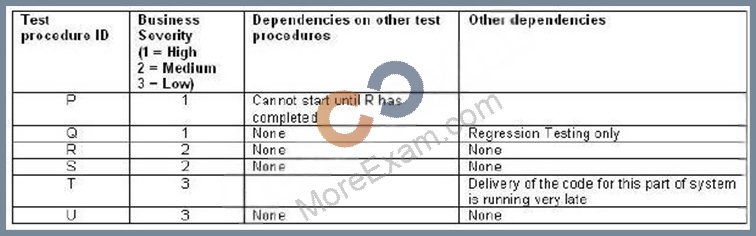
The above table shows 6 test procedures (P to U) that must now be entered into a test execution schedule.
Business severity is regarded as the most important element in determining the sequence of the test procedures, but other dependencies must also be taken into consideration. Regression testing can only be run once all other tests have completed.
Which of the following represents the MOST effective sequence for the test execution schedule (where the first entry in the sequence is the first procedure to be run, the second entry is the second to be run and so on)?

Question36: Which of the following statements describe why experience-based test design techniques are useful?
a) They can help derive test cases based on analysis of specification documents.
b) They can identify tests not easily captured by formal techniques.
c) They make good use of tester knowledge, intuition and experience.
d) They are an effective alternative to formal test design techniques.

Question37: A program level Master Test Plan states that a number of best practices must be adopted for its project life cycle models, irrespective of whether a sequential or iterative-incremental approach is adopted for each project.
Which of the following life cycle related best practices would you expect to see in the Master Test Plan?
a) There should be a testing activity that corresponds to each development activity.
b) Each project should have four test levels if using a V-model.
c) Test personnel should ensure that they are invited to review requirements and design documents as soon as draft versions are available.
d) System testing must not be performed by the development teams.

Question38: A system under development contains complex calculations and decision logic, and it is assessed as high risk because of the relative inexperience of the development team in the application domain.
Which of the following would be the MOST appropriate choice of test design technique for component testing?

Question39: Given the following sample of pseudo code:
Read A, B, C;
If A > B then
Print "Primary ratio is" & A / B;
End If
If A > C then
Print "Secondary ration is" & A / C;
End If.
Which of the following test cases would achieve 100% statement coverage?

Question40: Which of the following activities would improve how a tool is deployed within an organization?
a) Roll out the tool across the organization as quickly as possible to all users.
b) Provide technical support to the test team for each type of tool.
c) Limit communication with the tool vendor to allow users to develop their own best practice.
d) Make sure processes are improved to reflect a new tool.
e) Regularly analyze how the tool is being used.

Question41: For which of the following is Impact Analysis ESPECIALLY important?

Question42: A simple gaming system has been specified as a set of use cases. It has been tested by the supplier and is now ready for user acceptance testing. The system is assessed as low risk and there is pressure to release the software into the market as soon as possible.
Which of the following test techniques would be most appropriate for this testing?

Question43: From a Testing perspective, what are the MAIN purposes of Configuration Management?
a) Identifying the version of software under test.
b) Controlling the version of testware items.
c) Developing new testware items.
d) Tracking changes to testware items.
e) Analyzing the need for new testware items.

Question44: Which one of the following methods for test estimation rely on information captured from previous projects?

Question45: Which of the following statements is GENERALLY true of testing?
a) Testing can show the presence of defects.
b) Testing reduces the probability of uncovered defects.
c) Testing can show that a previously present defect has been removed.
d) Testing can prove that software is defect free.

Question46: Which of the following is a MAJOR task of evaluating exit criteria and reporting?

Question47: Which two of the following are common attributes of maintenance testing?
a) It is carried out to ensure that the system will be reliable once in service.
b) It includes regression testing.
c) It requires the use of fully defined specifications.
d) It can include testing of a system after migration from one platform to another.

Question48: What is the MAIN benefit of designing tests early in the life cycle?
Question49: Which of the following statements are true in relation to component testing?
a) Stubs may be used.
b) May cover resource behavior (e.g. memory leaks).
c) Tests the interactions between software components.
d) Defects are typically fixed without formally managing these defects.

Question50: Which of the following statements describe why exploratory testing is a useful test design technique?
a) It can help derive test cases based on the internal structure of systems.
b) It is useful when there are limited specification documents available.
c) It is useful when there testing is constrained due to time pressures.
d) It is a cheaper alternative to more formal test design techniques.

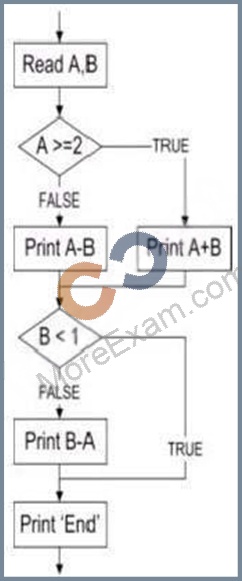
Question51: Given the following flow chart diagram:

What is the minimum number of test cases required for 100% statement coverage and 100% decision coverage, respectively?

Question52: What is the USUAL sequence for performing the following activities during the Fundamental Test Process?
a) Analyze the test basis documents.
b) Define the expected results.
c) Create the test execution schedule.
d) Establish the traceability of the test conditions

Question53: Which of the following are white-box test design techniques?
a) Decision table testing.
b) Decision coverage.
c) Boundary value analysis.
d) Error guessing.
e) Statement testing.

Question54: The digital rainbow Thermometer uses 7 colors to show the ambient temperature. Each color spans a range of just 5, with an operating minimum and maximum of minus 5 and 30. Which of the following values is minimum and maximum of minus 5 and 30.
Which of the following values is LEAST likely to have been identified when applying the boundary value test design technique?

Question55: Which of the following are true of software development models?
a) Component Integration testing is present in all good development models.
b) Acceptance testing can take place before system testing starts.
c) Acceptance testing should only start when system testing is complete.
d) There may be fewer than four test levels in a V-model.

Question56: Which of the following statements describe why error guessing is a useful test design technique?
a) It can help derive test cases based on analysis of specification documents.
b) It can identify tests not easily captured by formal techniques.
c) It can make good use of tester experience and available defect data.
d) It is a cheaper alternative to more formal test design techniques.

Question57: What should be the MAIN objective during development testing?
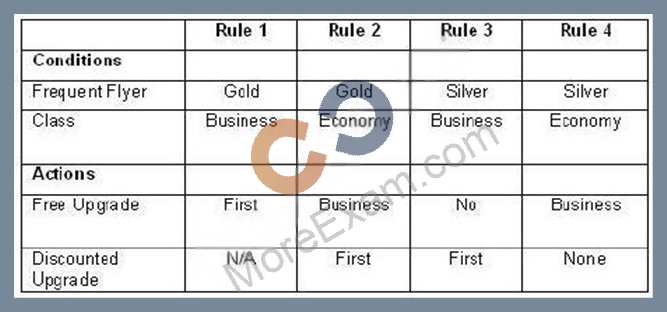
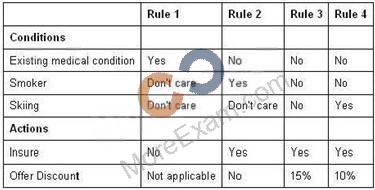
Question58: Given the following decision table:

What is the expected result for each of the following test cases?
P) Gold frequent flyer, travelling in Economy class.
Q) Silver frequent flyer, travelling in Business class.

Question59: Which of the following is a specification-based technique?

Question60: Which characteristics BEST describe a walkthrough?
Question61: Which of the following activities would improve how a tool is deployed within an organization?
a) Roll out the tool across the organization as quickly as possible to all users.
b) Conduct periodic lessons learn reviews with tool users.
c) Provide technical support to the test team for each type of tool.
d) If a tool is not being used, withdraw it and look for an alternative.
e) Make sure processes are improved to reflect a new tool.

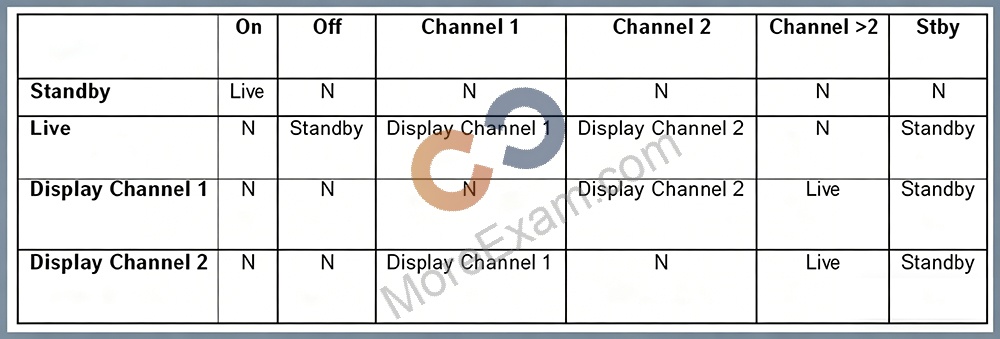
Question62: Given the following state table:

Which of the following represents an INVALID transition (N)?

Question63: What is the purpose of configuration management in testing?
a) To choose and implement a suitable configuration management tool.
b) To identify unique items of testware and their related developed software.
c) To provide traceability between items of testware and developed software.
d) To enable managers to configure the software.
e) To control the versions of software released into the test environment.

Question64: Given the following sample of pseudo code:
Input ExamScore
If ExamScore <= 75 then
Print "Candidate has failed"
Else
Print "Candidate has passed"
If ExamScore >= 120 then
Print "Candidate has achieved a distinction"
EndIf
EndIf.
What is the minimum number of test cases required to guarantee 100% decision coverage?

Question65: Which one of the following statements about approaches to test estimation is true?

Question66: Which of the following are structure-based techniques?
a) Decision table testing
b) Boundary value analysis
c) Multiple condition coverage
d) Use case testing
e) Decision testing

Question67: The flow graph below shows the logic of a program for which 100% statement coverage and 100% decision coverage is required on exit from component testing.
The following test cases have been run:

Which of the following statements related to coverage is correct?

Question68: Which of the following would NOT NORMALLY be considered for a testing role on a project?

Question69: Which option BEST describes objectives for test levels within a life cycle model?

Question70:
The above table shows 6 test procedures (P to U) that must now be entered into a test execution schedule.
Business severity is regarded as the most important element in determining the sequence of the test procedures, but other dependencies must also be taken into consideration. Regression testing can only be run once all other tests have completed.
Which of the following represents the MOST effective sequence for the test execution schedule (where the first entry in the sequence is the first procedure to be run, the second entry is the second to be run and so on)?

Question71: Under what circumstances would you plan to perform maintenance testing?
a) As part of a migration of an application from one platform to another.
b) As part of a planned enhancement release.
c) When the test scripts need to be updated.
d) For data migration associated with the retirement of a system

Question72: Given the following decision table:

What is the expected action for each of the following test cases?

Question73: Which of the following BEST describes a keyword-driven testing approach?

Question74: Which of the following defects would NORMALLY be identified by a static analysis tool?
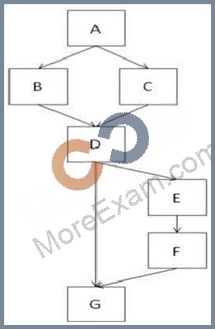
Question75: A system requires 100% decision coverage at component testing for all modules. The following module has been tested with a single test case.

The test case follows the path A, B, D, E, F, G.
What level of decision coverage has been achieved?

Question76: Which ADDITIONAL test level could be introduced into a standard V-model after system testing?

Question77: Which one of the following best describes risk-based testing?
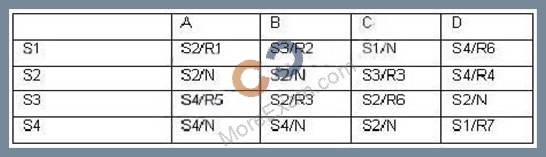
Question78: Consider the following state table:

Which of the following would result in a change of state to S2 with an action of R6?

Question79: Which one of the following is true of software development models?

Question80: When in the lifecycle should testing activities start?

Question81: Retirement of software or a system would trigger which type of testing?

Question82: Which of the following is LEAST likely to be included in an incident report?

Question83: The list below (a to e) describes one major task for each of the five main activities of the fundamental test process.
Which option (A to D) places the tasks in the correct order, by time?
a) Create bi-directional traceability between test basis and test cases.
b) Check test logs against exit criteria.
c) Define the objectives of testing.
d) Check planned deliverables have been delivered.
e) Comparing actual results with expected results.

Question84: Where may functional testing be performed?

Question85: During which activity of the Fundamental Test Process test process do you determine the exit criteria?

Question86: You have designed test cases to provide 100% statement and 100% decision coverage for the following:

How many MORE test cases are required?

Question87: Which two of the following are attributes of structural testing?
a) It is based on testing features described in a functional specification.
b) It can include statement and decision testing.
c) It can be carried out at all levels of testing.
d) It can include debugging.

Question88: During which activity of the Fundamental Test Process do you compare actual with expected results?

Question89: Which of the following statements is true?

Question90: Which one of the following is a characteristic of good testing in any lifecycle model?

Question91: Place the stages of the Fundamental Test Process in the usual order (by time).
a) Test closure activities.
b) Analysis and design.
c) Planning and control.
d) Implementation and execution.
e) Evaluating exit criteria and reporting.

Question92: A wholesaler sells printer cartridges. The minimum order quantity is 5. There is a 20% discount for orders of 100 or more printer cartridges. You have been asked to prepare test cases using various values for the number of printer cartridges ordered.
Which of the following groups contain three test inputs that would be generated using Boundary Value Analysis?

Question93: If a system has been tested and only a few defects have been found, what can we conclude about the state of the system?
a) The system may be defect free but the testing done cannot guarantee that this is true.
b) The system is defect free and further testing would therefore be a waste of resources.
c) It depends what the system is designed to do.
d) Further testing should be considered but this should be focused on areas of highest risk because it would not be possible to test everything.
e) Testing should be curtailed because it is yielding no value.

Question94: Which of the following are characteristics of good testing in any life cycle model?
a) Every development activity has a corresponding test activity.
b) Testers review development documents early.
c) There are separate levels for component and system integration test.
d) Each test level has objectives specific to that level.
e) Each test level is based on the same test basis.

Question95: Which statement about combinations of inputs and preconditions is true for a large system?

Question96: Which statement BEST describes the role of testing?
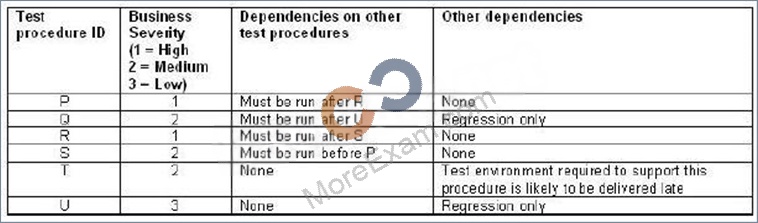
Question97:
The above table shows 6 test procedures (P to U) that must now be entered into a test execution schedule.
Business severity is regarded as the most important element in determining the sequence of the test procedures, but other dependencies must also be taken into consideration. Regression testing can only be run once all other tests have completed.
Which of the following represents the MOST effective sequence for the test execution schedule (where the first entry in the sequence is the first procedure to be run, the second entry is the second to be run and so on)?

Question98: What does a test execution tool enable?

Question99: Which of the following statements about black box and white box techniques is correct?

Question100: Four testers have each submitted an incident report in which each reported a problem with the User log-on process, a critical component of the system. The incident reports do not follow a prescribed template and the data needs to be entered into the project incident management tool.

Which tester has reported the incident most effectively to enable capture in the incident management tool, considering the information and priority they have supplied?

Question101: Which of the following is MOST likely to be an objective of a pilot project to introduce a test tool?

Question102: A system specification states that a particular field should accept alphabetical characters in either upper or lower case.
Which of the following test cases is from an INVALID equivalence partition?

Question103: During which activity of the Fundamental Test Process test process do you review the test basis?

Question104: Given the following decision table:

Which of the following test cases and expected results is VALID?

Question105: Arrive-and-Go airline wants to clarify its baggage handling policy, whilst maximizing revenues, and will introduce the following tariffs for all baggage per individual customer (weights are rounded up to the nearest 0.1Kg):
The first 2Kg will be carried free of charge. The next 10 Kg will be carried for a flat charge of 0. An additional 15Kg will be charged a total charge of 7.
Luggage over this amount will be charged at $5 per Kg, up to a maximum of 150Kg per person. No passenger may take more that 150Kg with them.
Which of the following would constitute boundary values for baggage weights in the price calculation?

Question106: In which activity of the Fundamental Test Process is the test environment set up?

Question107: Match the following formal review roles and responsibilities:
Roles:
1) Moderator.
2) Recorder.
3) Reviewer.
4) Manager.
Responsibilities:
p) The person chosen to represent a particular viewpoint and role.
q) The person who decides on the execution of inspections and determines if the inspection objectives have been met.
r) The person who leads the inspection of a document or set of documents.
s) The person who documents all the issues, problems and open points.

Question108: Which statement is a valid explanation as to why black-box test design techniques can be useful?

Question109: Which of the following account for most of the failures in a system?

Question110: Which of the following is a standard for test documentation?

Question111: The flow graph below shows the logic of a program for which 100% statement coverage and 100% decision coverage is required on exit from component testing.

The following test case has been run: Test Case 1 covering path A, B, D, G Which of the following ADDITIONAL test cases would need to be written to provide the required coverage?

Question112: Which of the following software work products would NOT TYPICALLY be examined using static analysis techniques?
a) Design specification.
b) Component code.
c) Software model.
d) Test procedure.
e) Non-functional requirements specification.

Question113: Which of the following types of defect are typically found in reviews rather than in dynamic testing?
a) Deviations from standards.
b) Defects in interface implementation.
c) Poor maintainability of code.
d) Poor performance of the system.
e) Defects in requirements.

Question114: Which of the following test activities are more likely to be undertaken by a test lead rather than a tester?
a) Create test specifications.
b) Schedule tests.
c) Define metrics for measuring test progress.
d) Prepare and acquire test data.

Question115: A candidate sits an exam with 40 questions. To pass, the candidate must answer at least 25 questions correctly. To gain a distinction, a mark of 32 or above must be achieved.
Which of these groups of exam scores would fall into three different equivalence classes?